
THE TIRED REVOLUTION: PRACTICING QUEER CRIP RESISTANCE
WRITTEN AND EDITED BY REMI STAMATELLOS
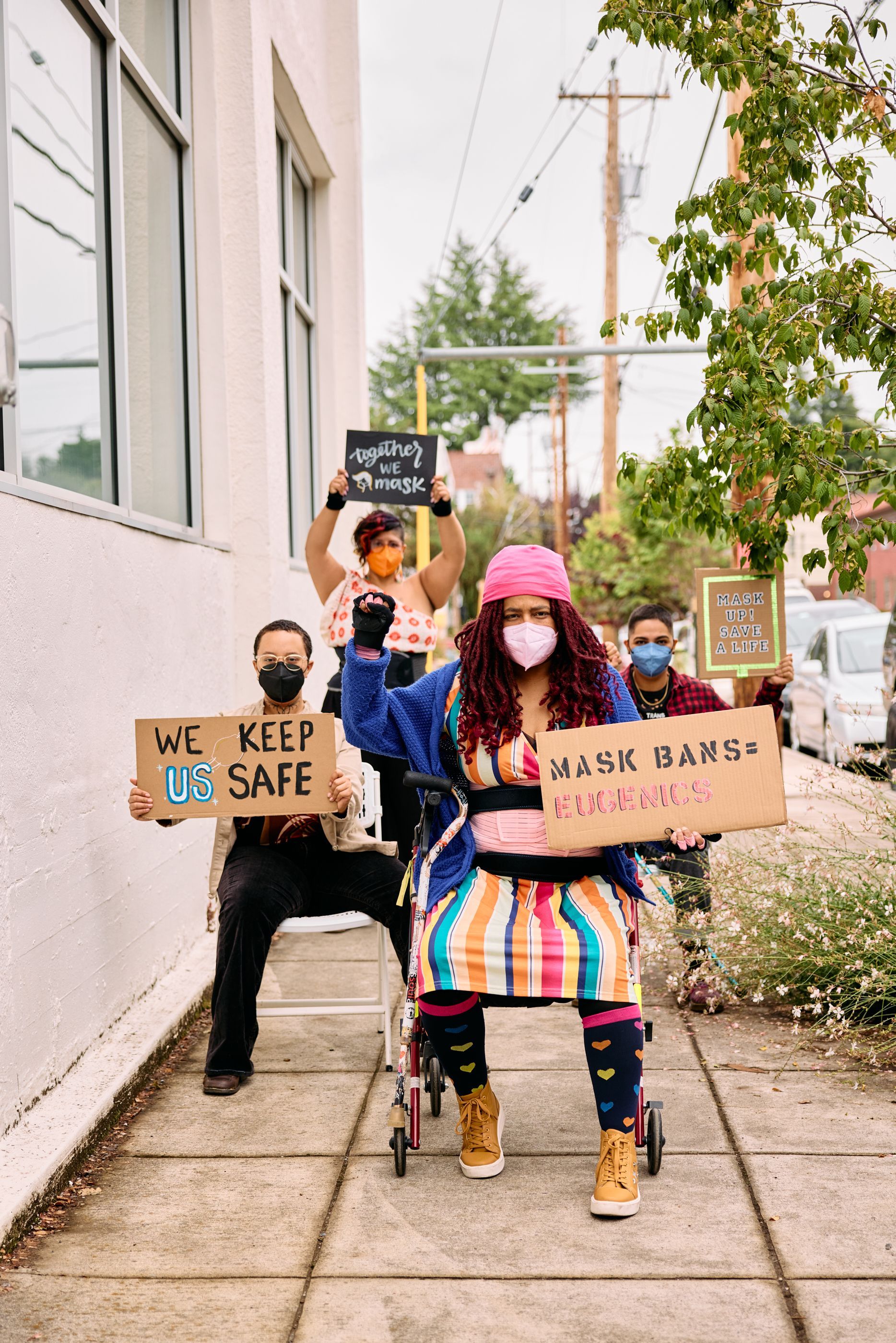
IMAGE CREDIT: DISABLED AND HERE
When tyranny strikes, intersectionally Queer & Disabled people are some of the first targets of bigotry and violence (especially if you're a Black or Brown individual). History lessons have told us protest is the only effective way to fight for our freedom. But what happens when that fight is inaccessible, life-threatening, or we are simply too unwell or exhausted to participate?
Queer, Trans, and Disabled folks have always been active in our own liberation, whether it's behind the scenes or at the front lines. Here are a few ways to resist fascism, whether it's from your bed or at city hall:
BEHIND-THE-SCENES WORK
Stealth activism is the backbone of any powerful movement. Below are a few accessible ways to advocate for yourself and communities outside of attending rallies:
Host online get-togethers & check-ins.
Building community, whether online or in-person, is an incredibly powerful way of resisting capitalism & independence culture. We need each other to survive and thrive. We remind each other what we are fighting for:
- Make a group chat and set time aside (weekly, bi-weekly, monthly) to check in on everyone. Maybe you can play games, stream a film, or just complain about the state of the world.
- Join a server or support group on Discord. I find groups that hold space for both the positive and negative aspects of our lived experience are most helpful.
Maintain and share cultural values & traditions.
One primary goal of fascism is to erode who we are and where we come from. Part of resistance means finding joy in and sustaining your cultural identity and traditions; as long as you are still here, no one has the authority to take your culture away:
- Teach your Transfemme friend how to do eyeliner (if she wants).
- Decorate your mobility aid with stickers, rhinestones, or flowers.
- Give your friend a gender-affirming haircut.
- Wear Queer symbols, like a carabiner, the pink triangle, or lavender.
- Share a family recipe or host a multinational potluck. If it's more accessible to do it online, take pictures and describe it in detail.
- Learn your native tongue and speak it, when you can, with family and friends.
Use free educational resources.
Learning about Queer/Disabled history, current events, political theory, and your rights doesn't always need to be expensive or complicated. Your local library and the *interwebs* will always have something to offer:
- Library: Check out books, use public wi-fi, utilize free computer access, and check out a meeting or study room.
- Online stuff: Download Wikipedia articles, browse the Internet Archive, and check out Marxist's Internet Archive or r/askhistorians.
- Make sure to cross-check the source's credibility. Verify citations & author credentials, check for unsupported claims or sweeping statements, identify the intended audience, and check the date for recency (things change!).
Find your niche, and trade.
Your skills are invaluable to community-building. If you can't offer money, try bartering goods and services. Your abilities or tools can be traded for something that you might need or struggle with:
- Good at growing and preparing food? Share it with your neighbors and friends!
- Good at organizing? Work behind the scenes to plan a protest.
- Good at communication? Mediate conflict between your group.
- Good at writing and editing? Make copy to send to your friends and local representatives.
- Know how to fix a car? Help your friend when it breaks down!
- Let your community borrow your oven, printer, book collection, or already-made posters.
Your art matters.
Art is the heartbeat of revolution. It strengthens our resolve, it unites us, and it sends authoritarian governments a message of exactly what must change.
- Make posters for protestors. I found 75 cent poster boards and a pack of markers for $2 (£1.5 or €1.75) at a local dollar store.
- Make zines, share political art, and promote your friends who make art for a living.
- Write non-fiction, poetry, opinion pieces, and publish them online and in print.
- If you sell art, don't sell it for cheaper than it's worth. Art is a time-consuming labor of love. If you undervalue your art, it undercuts both yours and other people's hard work.
Share resources when you find them.
This goes hand-in-hand with building community and trading knowledge and skills.
- Lost SNAP benefits: findhelp.org, feedingamerica.org
- Find remote job opportunity in your friend's field? Share it!
- Does your friend talk about experiencing chronic pain? Let them try your cane!
- Found a good list of name suggestions? Give it!
Email & call your local representatives.
This is a well-known way to participate in politics from home. Here's how to take it a step further, without over-extending yourself:
- Set a time that works best for your needs.
- Choose one or two causes to participate in during a certain time period (weekly, monthly, etc.) and stick to a goal number of calls/emails. Do your best to reach it, but do not increase this number (trust me, it prevents burnout).
- Make templates or read from a script to make the process more simple.
Stay present.
Doom-scrolling social media and constantly overwhelming yourself with news is not productive, it's paralyzing. Here's what I find helpful when looking to stay informed, but present:
- Set aside a day of the week to update yourself on current events.
- Touch grass, if possible. I mean it. We are not just fighting for the world inside our heads, but for the world we want to see.
- If you can't leave your house, open your window or take a break from technology by reading a book or practicing a hobby. Try to listen to grounding music.
- Practice rest as a necessary part of work. This will prevent burnout or crashes from happening sooner.
Reach out for help, pace yourself, and be mindful of spoons.
No one is capable of doing it all on their own. This is why it's so important to be mindful of your needs, triggers, and spoons (energy levels).
- Take longer on a project if you need. Nothing can happen overnight, even if you're a fast-paced worker.
- Disability and chronic illness can be unpredictable. If you can't make it this time, try to be there next time. Know your limits and communicate that you may not be consistently present.
- Have grace with yourself and ask for what you need, even if you can't reciprocate immediately.
FRONT-END RESISTANCE
There are major access obstacles in the front lines of the revolution. There will always be a risk of violence, injury, or illness. But if you would like to protest and rally, there are still ways to participate:
Know your rights.
Know your rights is a safety & resource guide for Disabled protestors. I found it incredibly useful attending protests myself.
Get creative with mobility aids.
- Bring a mobility aid, a comfortable chair, or a bed (for overnight) to accommodate for extended rallies.
- Use mobility devices to block police access to sit-ins or protected buildings.
- The 504 Sit-In protests are a great example of how Disabled protestors can occupy space and cause public interruptions.
Organize caravan protests.
For Disabled activists with mobility issues or concerns about direct bodily harm, injury, or illness, but still want to participate in a protest, all-vehicle protests can be a viable option!
- Hold posters or flags outside of your window.
- Temporarily spray paint your windshield.
- Continue to exercise safety precautions and know your rights. There is still a risk of violence.
Teach and learn signals that indicate police or ICE agent presence.
This point is closely connected to sharing skills and resources, but would be used in a politically-charged or potentially unsafe environment. Here are a few resources and suggestions:
- Use knowledge of sign language to communicate among fellow protestors.
- Pass out know your rights cards!
- ASL Dictionary (app): Useful for basic signs and fingerspelling for American Sign Language
- ICE Signals:
- ICE sighting: 3 short bursts (tweet-tweet-tweet)
- ICE abduction: 3 long bursts (tweeeeeet-tweeeeeet-tweeeeeet)
- Repeat until a crowd forms, and keep a safe distance.
Advocate for disability access at social justice events.
Not all social justice events are designed with accessibility in mind. Venues with stairs, protests on hills, or large gatherings without masks exclude Disabled folks from participating in their own liberation.
- Speak with organizers on accessible locations, including rest spots & accessible bathrooms.
- Speak up for yourself and mobility aid-users who are disrespected or discarded in crowds.
- Hand out masks, whistles, and water bottles. Put resources in local library boxes.
Sources:
- Be the Change: Six Disabled Activists On Why the Resistance Must Be Accessible
- Crip The Resistance: Thoughts and Resources for Accessible Protests
- Cripping The Resistance: No Revolution Without Us
- I Belong to the Home-Fires Resistance
ABOUT THE AUTHOR
Remi Stamatellos (they/them/elle) is a chronically ill, Nonbinary Femme Lesbian and one of The Snapdragon’s founders. They graduated from the University of West Georgia with a B.A. in English and certificate in Publishing and Editing.
Remi primarily works as the editor-in-chief, copywriter, web designer, and events planner for The Snapdragon. Their goal is to give fellow LGBTQ+ and Disabled people the opportunity to share their mutual experiences without the risk of feeling ostracized. Beyond their magazine duties, they love to bake, sing, and fawn over their cats.